
Why MediGlow Invested in the Cutera Enlighten SR – and Why We Were First in Scotland
When we launched MediGlow Aesthetics & Health in December 2024, our goal was never to be “just another aesthetics clinic.” Pompi Chatterjee and I are both GPhC-registered Pharmacist Independent Prescribers, and from day one we wanted MediGlow to be led by that clinical background rather than by trends. That philosophy is exactly why, in June 2026, we made the decision to bring the Cutera Enlighten SR picosecond laser into our clinic in Thornliebank, Glasgow – and why we became the first clinic in Scotland to offer it.
This wasn’t a small decision, and it sat alongside the rest of our device stack (Nd:YAG, Laser Genesis and LimeLight IPL) as part of a genuine, ongoing commitment to pigmentation and skin rejuvenation treatment. Here’s the thinking behind it.
The gap we kept seeing in the market
Running skin analysis consultations week after week, a pattern became impossible to ignore: pigmentation – and melasma in particular – is one of the most common concerns walking through the door, and one of the most poorly served by the existing Glasgow and wider Scottish aesthetics market.
Most local clinics were offering the same narrow toolkit: chemical peels, topical brightening creams, and occasionally an IPL or Q-switched laser that wasn’t designed with mixed-depth pigmentation in mind. For patients with genuine melasma – especially those with darker or more melanin-rich skin, Fitzpatrick types III to VI – that toolkit is limited, and in some cases actively risky. Older, longer-pulse-duration lasers generate more heat in the skin, and heat is one of the main triggers for post-inflammatory hyperpigmentation (PIH) – which means a poorly chosen device can leave patients with darker skin worse off than when they started.
We saw a clear, unmet need: a device platform that could treat pigmentation safely across a wide range of skin tones, without the downtime or rebound pigmentation risk that comes with older technology. Nobody in Scotland had brought in the technology to properly close that gap.
Why picosecond technology, specifically
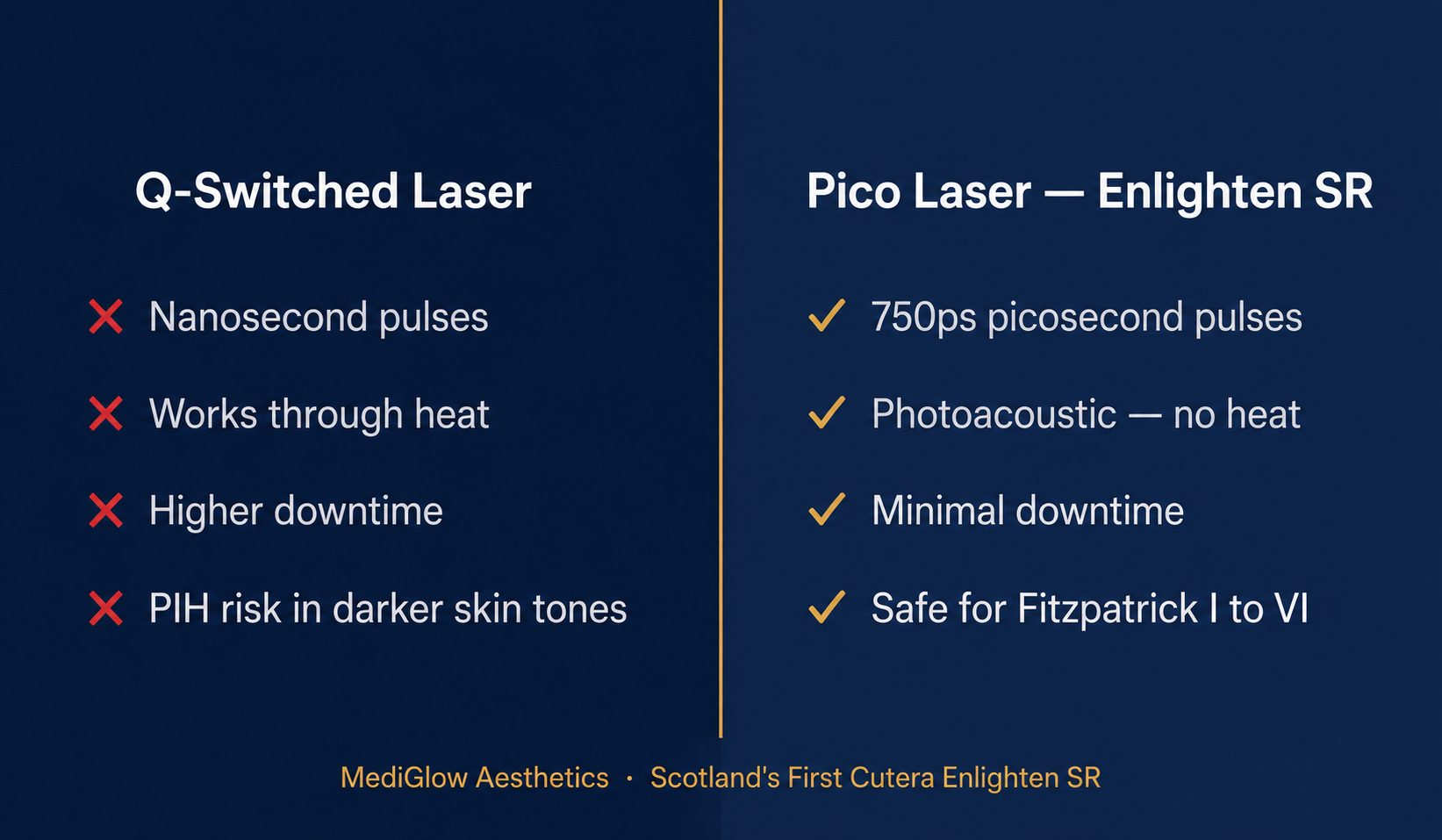
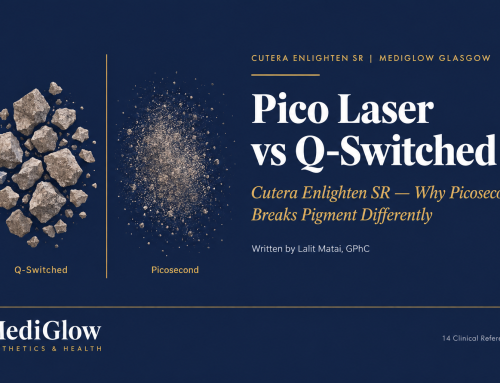
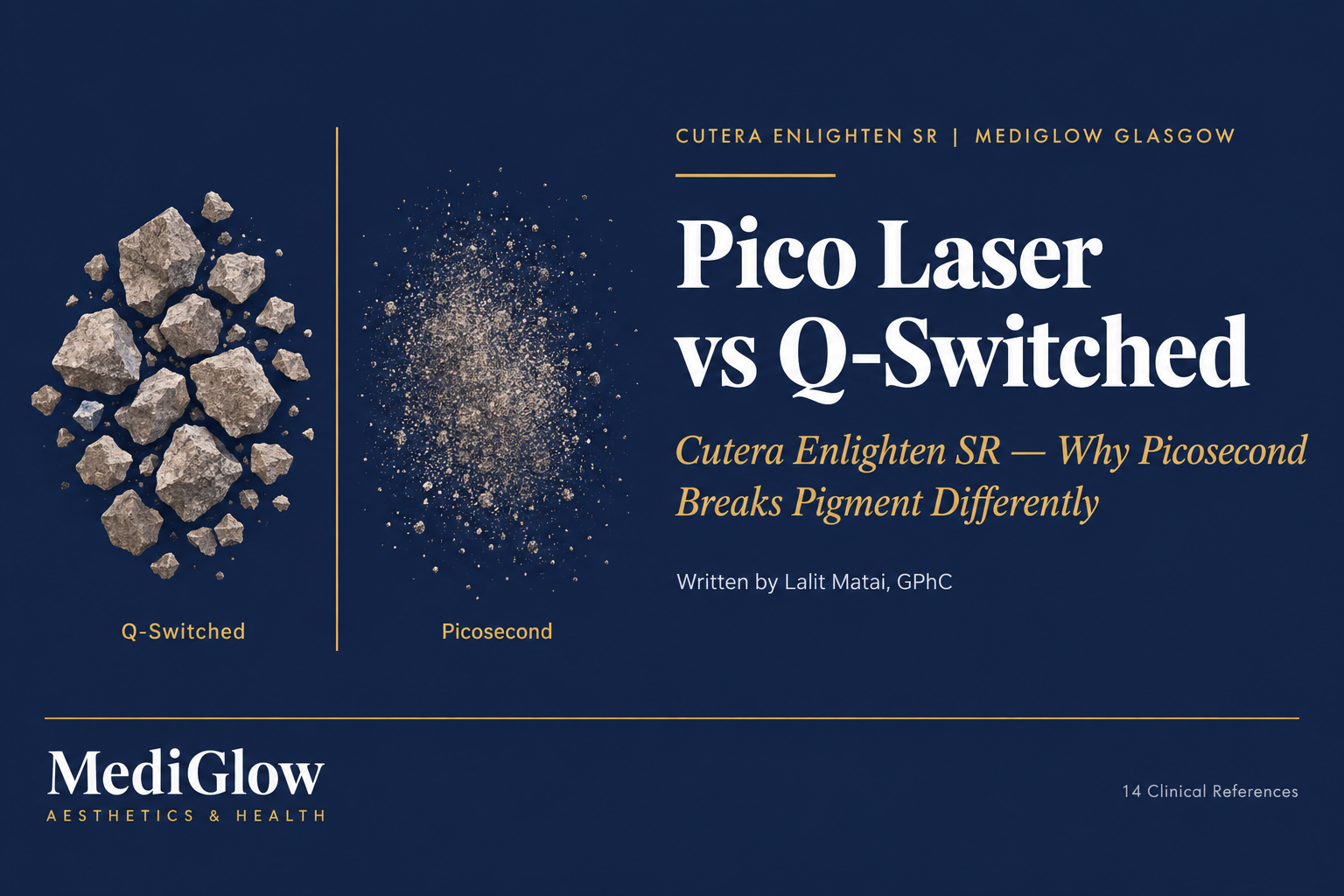
Pico laser vs Q-switched laser comparison -photoacoustic versus photothermal mechanism, Cutera Enlighten SR at MediGlow Glasgow
Picosecond lasers work fundamentally differently to the older Q-switched (nanosecond) devices most clinics rely on. Instead of heating pigment until it breaks down thermally, a picosecond laser delivers energy in ultra-short pulses – billionths of a second – that shatter pigment particles mechanically (a photoacoustic, rather than photothermal, effect). Less heat reaches the surrounding tissue, which is precisely the mechanism that makes picosecond technology more forgiving for melasma and for deeper skin tones.
The clinical literature on this has been building for several years now. Trials using 1064nm picosecond wavelengths – the setting we lean on most for melasma – have repeatedly shown meaningful improvement in melasma severity scores with a strong safety profile, including in split-face and randomised controlled study designs. Multiple studies have specifically praised the low downtime and reduced risk of triggering PIH compared with older laser toning approaches, which is the single biggest fear patients bring to a first consultation. That evidence base – not marketing hype – is what made the clinical case straightforward for us, even before we looked at anything else.
Why Cutera Enlighten SR over the alternatives
We didn’t choose the Enlighten SR on a whim. We put it through a genuine head-to-head evaluation against the other leading picosecond platform on the market, the Candela PicoWay, looking closely at FDA 510(k) clearance data and real-world protocol flexibility. We chose the best available FDA-cleared platform on the market, not the cheapest or the easiest option – because for us, that decision is a direct reflection of our commitment to patient safety and to results, not a commercial shortcut.
The Enlighten SR gave us the versatility we were looking for in one platform: multiple treatment modes (including 2D, 3D and 4D protocols) that let us tailor depth and intensity to melasma, dermal pigmentation, tattoo removal and general skin rejuvenation from the same machine, rather than needing separate devices for each concern. That versatility, backed by strong clinical evidence and FDA clearance, is what gave us the confidence to bring it into MediGlow and put our name behind it as the first clinic in Scotland to do so.
Our clinical background – why that matters here
Lasers in the wrong hands are not harmless. Picosecond devices are powerful, and getting the settings, wavelength and cooling protocol wrong – particularly on darker skin – is how patients end up with burns or rebound pigmentation that’s worse than their original concern.
Both Pompi and I are Pharmacist Independent Prescribers regulated by the GPhC, and I trained directly under Dr Tim Pearce, founder of Skin Viva and Derma Medical – clinics built on rigorous, medically-led aesthetic practice rather than a beautician-style approach. Alongside that foundation, our laser-specific certification, training and ongoing clinical support came directly through Cutera. That combination is what let us build a proper, structured protocol menu for the Enlighten SR rather than just following a generic manufacturer setting sheet: individualised treatment planning based on Fitzpatrick type, MC10 skin-analysis data, and a genuine differential diagnosis process before a single pulse is fired.
We’re also able to pair in-clinic laser sessions with bespoke prescription-only topicals where the clinical picture calls for it – building a combination approach for melasma rather than relying on the laser in isolation. The evidence is fairly consistent on this point too: picosecond laser tends to work best as part of a broader regimen, alongside topical maintenance, rather than as a standalone fix, and melasma has a well-documented tendency to recur without ongoing management.
What this means for patients
For a patient sitting in our consultation room with melasma, in practical terms this means:
- A treatment option that doesn’t require them to have fair skin to be a safe candidate
- Meaningfully less downtime than older resurfacing or peeling approaches
- A protocol built around their specific skin analysis data, not a one-size-fits-all setting
- A prescribing clinician involved in their care, not just an aesthetician running a machine
- Access to prescription-only topicals alongside laser treatment where the clinical picture calls for it
Being first in Scotland
Being the first clinic in Scotland to bring in the Enlighten SR wasn’t the goal in itself – it was a consequence of taking the gap in the market seriously and refusing to settle for a lesser device just because it was already available locally. It’s also, honestly, a reflection of where MediGlow has got to since December 2024: a clinic that’s grown to the point where bringing in genuinely best-in-class clinical infrastructure, and standing behind it with real prescribing expertise, was simply the right thing to do for our patients.
If you’re dealing with melasma or stubborn pigmentation and you’ve tried the usual creams and peels without lasting results, this is exactly the kind of case the Enlighten SR was brought in for. Book a skin analysis consultation with us and we’ll talk you through whether it’s the right fit for your skin.