

Acne scar treatment
in Glasgow

When the acne clears but the marks remain

GPhC registered
Scotland's first Enlighten SR
Skin Laser Specialists

Most patients who come to us about acne scars have been living with them for years. They have tried the vitamin C serums, the retinol creams, the glycolic peels. Some have tried other clinics. The improvement, if any, has been modest. The explanation they usually receive is that scars are permanent and there is only so much that can be done.

That is not entirely wrong. Acne scars are permanent changes to the architecture of the dermis — collagen and elastin disrupted by the deep inflammation of cystic or nodular acne. They cannot be erased. But the right clinical protocol can meaningfully reduce scar depth, improve the surrounding skin quality, and significantly reduce how visible the scarring is. There is a real difference between scarring that dominates someone’s daily confidence and scarring that requires close inspection to notice.

At MediGlow in Thornliebank, Glasgow, we treat acne scarring using two clinically evidenced approaches: PICO Genesis FX on the Cutera Enlighten SR, and SkinPen microneedling. In patients with significant scarring, we often combine both. We are also pharmacist independent prescribers, which means we can add prescription-grade topicals to a combined course where the clinical picture calls for it — something most aesthetics clinics cannot offer.

We serve patients with acne scarring from across Glasgow Southside including Newton Mearns, Giffnock, East Kilbride and Clarkston. Treatment suitability is assessed at consultation. Individual results vary.

At a glance

ConditionAtrophic acne scarring
Scar types treatedRolling, boxcar, post-acne PIH
How commonAffects up to 56% of people with acne, rising sharply with acne severity
Treatments at MediGlowPICO Genesis FX · SkinPen PDRN
DeviceCutera Enlighten SR — Scotland's first
Suitable skin typesFitzpatrick I–VI
Sessions (typical)3–6 depending on concern
Results vary. Consultation required before treatment.

Understanding your scars

The main types of acne scar

Correctly identifying your scar type is the single most important step in treatment planning. Different scars respond differently to different protocols. At MediGlow, every treatment plan starts with a full clinical assessment and skin analysis.

Responds well to treatment

Rolling scars

The most common type. Broad, shallow depressions with gently sloping edges that give the skin an undulating appearance. Caused by fibrous bands connecting the dermis to the subcutaneous tissue, pulling the skin surface inward.

Rolling scars respond well to PICO Genesis FX and SkinPen Precision Elite, both of which stimulate collagen remodelling in the mid-dermis.

Good response — depth determines approach

Boxcar scars

Round or oval depressions with sharper, more defined vertical edges. Shallower boxcar scars respond well to collagen-stimulating treatments. Deeper boxcar scars may benefit from a combined or extended course.

We assess boxcar scar depth at consultation and discuss realistic outcomes based on your individual presentation before any treatment begins.

Requires combined approach

Ice pick scars

Narrow, deep channels that extend into the dermis. The most challenging scar type to treat. PICO Genesis FX can improve the surrounding skin quality, but true ice pick scars often respond better to TCA CROSS — a specific chemical reconstruction technique delivered into each channel.

If ice pick scars are your primary concern, we will discuss this honestly at consultation and plan the most appropriate approach.

Post-inflammatory hyperpigmentation (PIH)

The dark marks left after acne breakouts. Technically not scars — they are pigmentation changes rather than structural damage — but they are often the primary concern for patients with South Asian or darker skin. Pico Laser is particularly effective for PIH. At MediGlow, as pharmacist independent prescribers, we can also combine laser sessions with prescription-grade topicals that target the melanogenesis pathway directly, which most aesthetics clinics cannot prescribe.

Clinical note

Active acne must be under control before scar treatment begins. Treating over active breakouts risks worsening existing scarring and reducing the effectiveness of any laser or microneedling protocol. We assess this at consultation and will advise on timing before any treatment is planned.

Treatment options

How we treat acne scars at MediGlow

We offer two evidence-based treatments for acne scarring. For most patients with significant scarring, we recommend a combined protocol that alternates both across a structured course.
Treatment 1

PICO Genesis FX

Cutera Enlighten SR — Scotland's first clinic to offer this platform

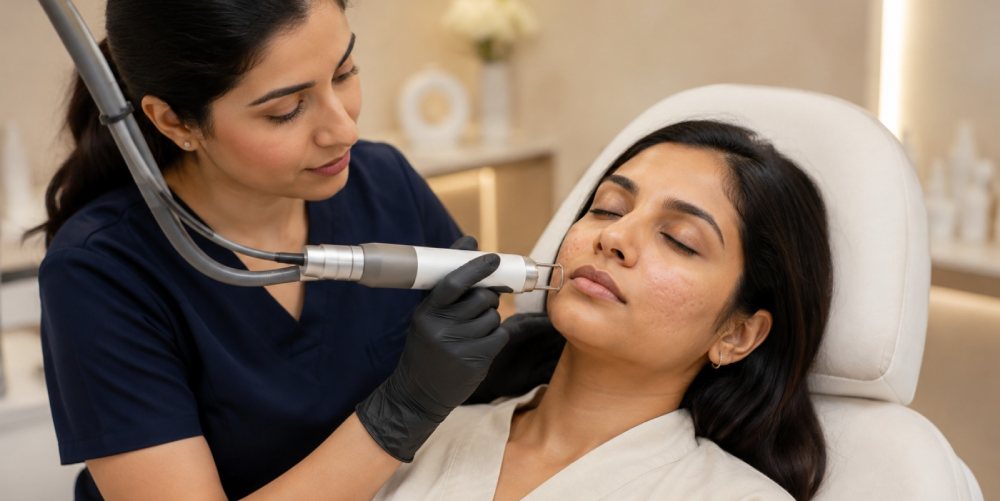
Using the Micro Lens Array (MLA) handpiece on the Cutera Enlighten SR, PICO Genesis FX delivers 750 picosecond energy fractionally into the dermis. This creates thousands of microscopic zones of controlled optical disruption — Laser-Induced Optical Breakdowns (LIOBs). The skin responds by activating fibroblasts to produce new collagen and elastin, progressively improving scar depth and skin texture.

Because the mechanism is photoacoustic — energy delivered through pressure rather than heat — the epidermis remains intact. No ablation. No open wounds. Downtime is typically mild redness and frosting (a temporary white effect on treated skin) resolving within 2 to 4 hours.

Clinical evidence

A 17-week randomised, split-face controlled trial of the 1064 nm picosecond laser with diffractive lens/microlens array — the same wavelength and lens technology as the Cutera Enlighten SR — found up to a 54.6% reduction in acne scar severity (ECCA scale), outperforming a comparator 1550 nm erbium-glass laser's 41.9% reduction, in Asian-skin patients. This is supported by further split-face trial evidence showing the 1064 nm picosecond/microlens platform performs comparably to ablative resurfacing while causing significantly less downtime and a lower rate of post-inflammatory pigmentation.

JAMA Dermatology · PMID 25409158 · Clinical trial evidence
Full details on our Pico Laser treatments

Best suited for

Rolling and shallow boxcar scars
Post-inflammatory hyperpigmentation
Mixed acne damage (pigment + texture)
Standardise to "Fitzpatrick I–VI"
Patients who need minimal downtime

45–65%

typical improvement in scar depth (3–4 sessions)

3–5

sessions for most presentations

Fitz I–VI

FDA-cleared for all skin types
Treatment 2

SkinPen Precision Elite

Collagen induction + regenerative polynucleotide therapy

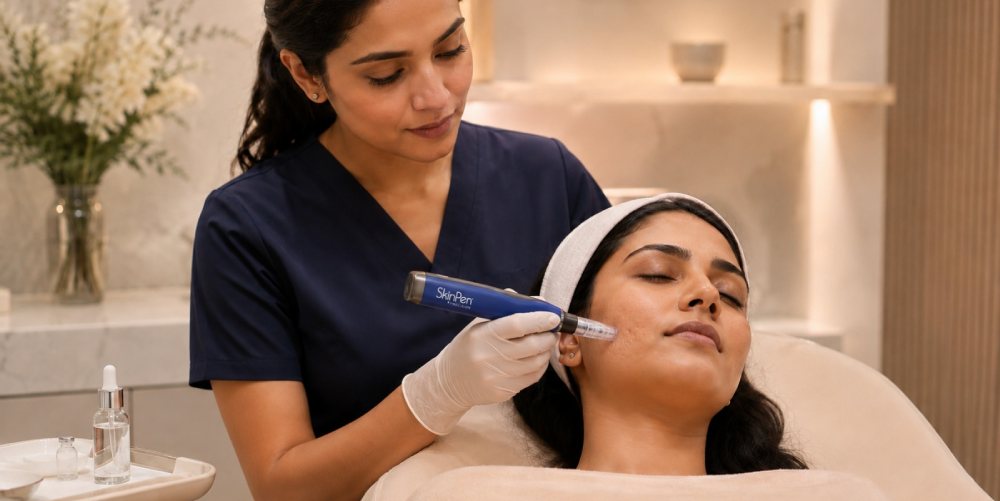
SkinPen creates controlled micro-injuries across the treatment area, triggering the skin's natural collagen induction response. Combined with PDRN (polydeoxyribonucleotide) — a biostimulant derived from salmon DNA that is 95 per cent compatible with human DNA — the treatment stimulates deeper cellular repair than microneedling alone.

PDRN activates fibroblast proliferation and new collagen synthesis through VEGF stimulation, and reduces inflammatory cytokines IL-6 and TNF-alpha — creating an environment where scarred tissue can remodel more efficiently. The micro-channels created by SkinPen enhance PDRN absorption significantly compared to topical application alone.

Clinical evidence

PDRN can be added to either treatment as an optional regenerative boost. A randomised, placebo-controlled trial of purified polynucleotide injections in patients with moderate to severe acne scars found significant improvement over placebo. Its mechanism — stimulating fibroblast activity and collagen synthesis while reducing inflammatory signalling — is well established in the wound-healing literature. We discuss whether PDRN is worth adding to your protocol at consultation, based on your scar type and skin goals.

Multiple Korean RCTs · Clinical evidence base · Peer-reviewed literature
Full details on our microneedling with PDRN

Best suited for

Rolling and shallow boxcar scars
Overall skin texture and enlarged pores
Patients who prefer a non-laser approach
Combined course with PICO Genesis FX
All skin tones — no heat, no PIH risk

30–60%

improvement in scar depth (6-session protocol)

4–6

sessions for acne scar protocols

Zero heat

safe for all skin types including Fitzpatrick IV–VI

A combined protocol — and what sets MediGlow apart

For most patients with significant acne scarring, a combined protocol delivers more comprehensive improvement than either treatment alone. We typically alternate PICO Genesis FX and SkinPen Precision Elite microneedling across a structured course — the laser creates photoacoustic dermal disruption that stimulates collagen from one direction, and the controlled micro-injury of microneedling adds regenerative fibroblast activity from another. PDRN can be added to either stage of the course as an optional enhancement.

The clinical literature on combined approaches is consistent: picosecond laser combined with polynucleotide therapy gives better results than monotherapy. These combined approaches also appear to decrease downtime and reduce post-procedure irritation compared to ablative laser alternatives.

For patients with post-acne pigmentation alongside structural scarring, we can also incorporate prescription-grade topicals — including tranexamic acid and retinoid formulations — into the treatment plan. As GPhC-registered pharmacist independent prescribers, Pompi and Lalit can prescribe these directly. Most aesthetics clinics cannot.

Why Pico Laser rather than CO2 or ablative resurfacing

Ablative fractional CO2 lasers are effective for deep textural remodelling but require significant downtime and carry a higher risk of post-inflammatory hyperpigmentation in Fitzpatrick IV to VI skin. Head-to-head clinical trials show Pico Laser offering advantages in pigment clearance, lower downtime, and reduced thermal injury. For patients with South Asian or darker skin — a significant proportion of MediGlow's patient base — this is not an interchangeable choice. The Cutera Enlighten SR at 1064nm was chosen specifically because of its proven safety profile across all skin tones.

Example combined course

1 PICO Genesis FX — Enlighten SR
2 SkinPen Precision Elite
3 PICO Genesis FX — Enlighten SR
4 SkinPen Precision Elite (+ PDRN optional at either stage)
Sessions spaced 4–6 weeks apart.
Course tailored at consultation.

The prescriber advantage

Pompi and Lalit are GPhC-registered pharmacist independent prescribers. They can prescribe retinoids, tranexamic acid and compounded formulations as part of your treatment plan — targeted at the melanogenesis pathway for post-acne pigmentation. This is not available at most aesthetics clinics.

Safe for South Asian, East Asian and Afro-Caribbean skin

This matters significantly for MediGlow's patient base across Newton Mearns, Giffnock and Glasgow Southside, where a significant proportion of patients have South Asian or East Asian skin.

Ablative lasers and some older fractional systems carry a higher risk of post-inflammatory hyperpigmentation in Fitzpatrick IV to VI skin. Heat stimulates melanin production — and in higher-melanin skin, that response is stronger. A treatment that effectively clears scarring in Fitzpatrick II skin can make pigmentation significantly worse in Fitzpatrick V skin if the wrong device is used.

The Cutera Enlighten SR at 1064nm is FDA-cleared for Fitzpatrick I through VI. The photoacoustic mechanism — pressure not heat — substantially reduces PIH risk. SkinPen Precision Elite involves no heat at all. Both treatments at MediGlow are appropriate for darker skin tones, and the Enlighten SR was chosen specifically with this patient group in mind.

If you have been told by another clinic that your skin tone makes laser unsuitable for you, we encourage you to read more before assuming this applies to Pico Laser at 1064nm.

Read our guide to laser treatments for South Asian skin

What to expect

What happens from consultation to results

1

Consultation and skin analysis

Pompi or Lalit reviews your medical history, current medications, acne history and your specific scar presentation. We carry out Fitzpatrick skin typing and advanced skin analysis using our MC10 multi-spectral imager where appropriate — which identifies sub-surface scar depth not visible during a standard clinical assessment. No treatment begins without a clinical consultation. There is no obligation at the consultation stage.

2

Treatment plan agreed — including patch test

We confirm which scar types are present, which treatments are appropriate, the recommended course structure, what realistic results look like for your specific presentation, and the full cost. A patch test is carried out for all first laser treatments. We will also discuss whether prescription topicals should be incorporated into your plan. No surprises. Everything confirmed before a single treatment begins.

3

Treatment sessions

PICO Genesis FX sessions take 30 to 45 minutes. Topical numbing cream is applied 45 minutes before the laser begins. Most patients describe the sensation as sharp snapping pulses — comparable to a rubber band against the skin. SkinPen Precision Elite takes 45 to 60 minutes. Both are well tolerated. Mild redness after PICO Genesis FX resolves within 2 to 4 hours. SkinPen Precision Elite typically causes redness for 24 to 48 hours.

4

Results timeline and course completion

New collagen production begins immediately after each session but takes 4 to 8 weeks to become visible on the skin surface. Results continue to develop for up to 3 months after each session as collagen matures. Progressive improvement builds across the course. Most patients begin to see meaningful change after session 2 or 3. Strict SPF 50 protection throughout the course is essential — sun exposure can both worsen PIH and reduce treatment effectiveness.

Client Testimonials

★★★★★

I went along to MediGlow to finally start my laser tattoo removal treatment with Pompi & Lalit. They were both very supportive throughout as I was a little nervous about the process & the pain, I felt at ease & all my questions were answered. The treatment itself was less uncomfortable than I had anticipated & I’m excited for the rest of my treatments to see the end result that I have been putting off for too long.

Erika Cunningham

★★★★★

I am having a tattoo removed at Mediglow and got to try their new Lazer. The whole process was well explained, the staff were knowledgeable and put me at ease throughout the procedure. Lalit contacted me several times afterwards to ensure I was ok and the tattoo was healing well. I will require a few more treatments, but I know that I am in professional hands.

Allison Wilson

★★★★★

Highly recommend Mediglow Aesthetic & Health! I’ve been taking laser sessions here and the experience has been fantastic. Pompi is extremely professional, kind, and attentive. She makes every session comfortable and always answers questions patiently. The clinic is clean, hygienic, and provides excellent service. Very satisfied with my experience so far!

Ibtesam Waheed

Frequently Asked Questions

We treat rolling scars, shallow to moderate boxcar scars, and post-inflammatory hyperpigmentation using PICO Genesis FX and SkinPen Precision Elite. Ice pick scars can be partially improved with Pico Laser but typically respond better to TCA CROSS — we discuss this honestly if it applies to you. The starting point for every patient is a full consultation where we assess which scar types are present and which treatment approach is most appropriate for your specific presentation.

This depends on your scar type and severity. PICO Genesis FX for rolling and boxcar scars typically needs 3 to 5 sessions spaced 4 to 6 weeks apart. SkinPen Precision Elite for acne scars typically needs 4 to 6 sessions. For patients on a combined protocol — alternating both treatments — a course of 4 to 8 sessions total is typical. Results build progressively. Most patients see meaningful improvement after session 2 or 3, with optimal results 2 to 3 months after completing the full course. Your treatment plan is confirmed at consultation after a full skin assessment.

They work through different mechanisms and for most patients with significant scarring, a combination delivers better results than either alone. PICO Genesis FX targets pigmentation and creates collagen stimulation through photoacoustic optical breakdown — making it particularly effective for mixed presentations of texture and pigment. SkinPen Precision Elite adds regenerative polynucleotide therapy that specifically promotes fibroblast activity and skin barrier repair. The clinical evidence consistently shows combination approaches outperform monotherapy for atrophic acne scars. We discuss this at consultation and recommend based on your specific scar types.

Yes — and this is a critical question in this patient group. Both PICO Genesis FX on the Cutera Enlighten SR at 1064nm and SkinPen Precision Elite are appropriate for Fitzpatrick IV to VI skin. The Enlighten SR's photoacoustic mechanism works through pressure rather than heat, substantially reducing the post-inflammatory hyperpigmentation risk that heat-based ablative lasers carry in higher-melanin skin. The Cutera Enlighten SR is FDA-cleared for Fitzpatrick skin types I through VI. MediGlow treats a significant number of South Asian and East Asian patients and selected this device specifically with that clinical consideration in mind. All patients require Fitzpatrick typing at consultation before treatment parameters are set.

Yes. Active acne must be under control before scar treatment begins. Treating over active breakouts can worsen existing scarring and significantly reduce the effectiveness of any laser or microneedling protocol. If you are currently experiencing active breakouts, we discuss this at consultation and advise on timing — including whether prescription treatment to control the active acne should be considered before starting a scar course. As pharmacist independent prescribers, we can prescribe appropriately where indicated.

Minimal. Most patients return to normal activities the same day. Mild redness and occasional frosting — a temporary white powder effect on treated skin that is a normal response — typically resolve within 2 to 4 hours. Some patients experience mild swelling in the treated area for 24 hours. Sun exposure immediately after treatment should be avoided, and SPF 50 with iron oxide is essential throughout the treatment course. SkinPen Precision Elite typically causes redness and mild sensitivity for 24 to 48 hours. Makeup should be avoided for 24 hours after microneedling.

Three reasons specific to this clinic. First, MediGlow is Scotland's first and only Cutera Enlighten SR clinic — confirmed by Cutera directly. PICO Genesis FX is not available on this specific platform anywhere else in Scotland. Second, Pompi Chatterjee and Lalit Matai are GPhC-registered pharmacist independent prescribers. Every treatment assessment is led by a clinical prescriber who can review your full medical history, prescribe topical treatments alongside laser, and manage your care holistically — not just operate a device. Third, MediGlow has specific clinical experience treating acne scarring and post-acne hyperpigmentation in patients with South Asian and East Asian skin tones — Fitzpatrick IV to VI — for whom laser and device choice matters most.

Full reference list

  • Liu L, Xue Y, Chen Y, Chen T, Zhong J, Shao X, Chen J. Prevalence and risk factors of acne scars in patients with acne vulgaris. Skin Res Technol. 2023;29(6):e13386. doi:10.1111/srt.13386. PMID: 37357642.
  • Kwon HH, Choi SC, Lee SJ, et al. Comparison of a 1064-nm Nd:YAG picosecond laser using a diffractive optical element vs a nonablative 1550-nm erbium-glass laser for the treatment of facial acne scarring in Asian patients: a 17-week prospective, randomized, split-face, controlled trial. J Eur Acad Dermatol Venereol. 2020;34(12):2907–2913.
  • Dai R, Cao Y, Su Y, Cai S. Comparison of 1064-nm Nd:YAG picosecond laser using fractional micro-lens array vs. ablative fractional 2940-nm Er:YAG laser for the treatment of atrophic acne scar in Asians: a 20-week prospective, randomized, split-face, controlled pilot study. Front Med (Lausanne). 2023;10:1248831. doi:10.3389/fmed.2023.1248831.
  • Manuskiatti W, Punyaratabandhu P, Tantrapornpong P, Yan C, Cembrano KAG. Objective and long-term evaluation of the efficacy and safety of a 1064-nm picosecond laser with fractionated microlens array for the treatment of atrophic acne scar in Asians. Lasers Surg Med. 2021;53(7):899–905. doi:10.1002/lsm.23368. PMID: 33326626.
  • Minutilli E. Microneedling for treatment of acne scars: considerations on the successful management of this aesthetic procedure. J Drugs Dermatol. 2024;23(3):e79–e80.
  • Shen YC, Chiu WK, Kang YN, Chen C. Microneedling monotherapy for acne scars: systematic review and meta-analysis of randomized controlled trials. Aesthet Plast Surg. 2022;46(4):1913–1922. doi:10.1007/s00266-022-02845-3. PMID: 35426044.
  • Araco A, Araco F. Preliminary prospective and randomized study of highly purified polynucleotide vs placebo in treatment of moderate to severe acne scars. Aesthet Surg J. 2021;41(7):866–874.
  • Brauer JA, Kazlouskaya V, Alabdulrazzaq H, Bae YS, Bernstein LJ, Anolik R, Heller PA, Geronemus RG. Use of a picosecond pulse duration laser with specialized optic for treatment of facial acne scarring. JAMA Dermatol. 2015;151(3):278–284. doi:10.1001/jamadermatol.2014.3045. PMID: 25409158.