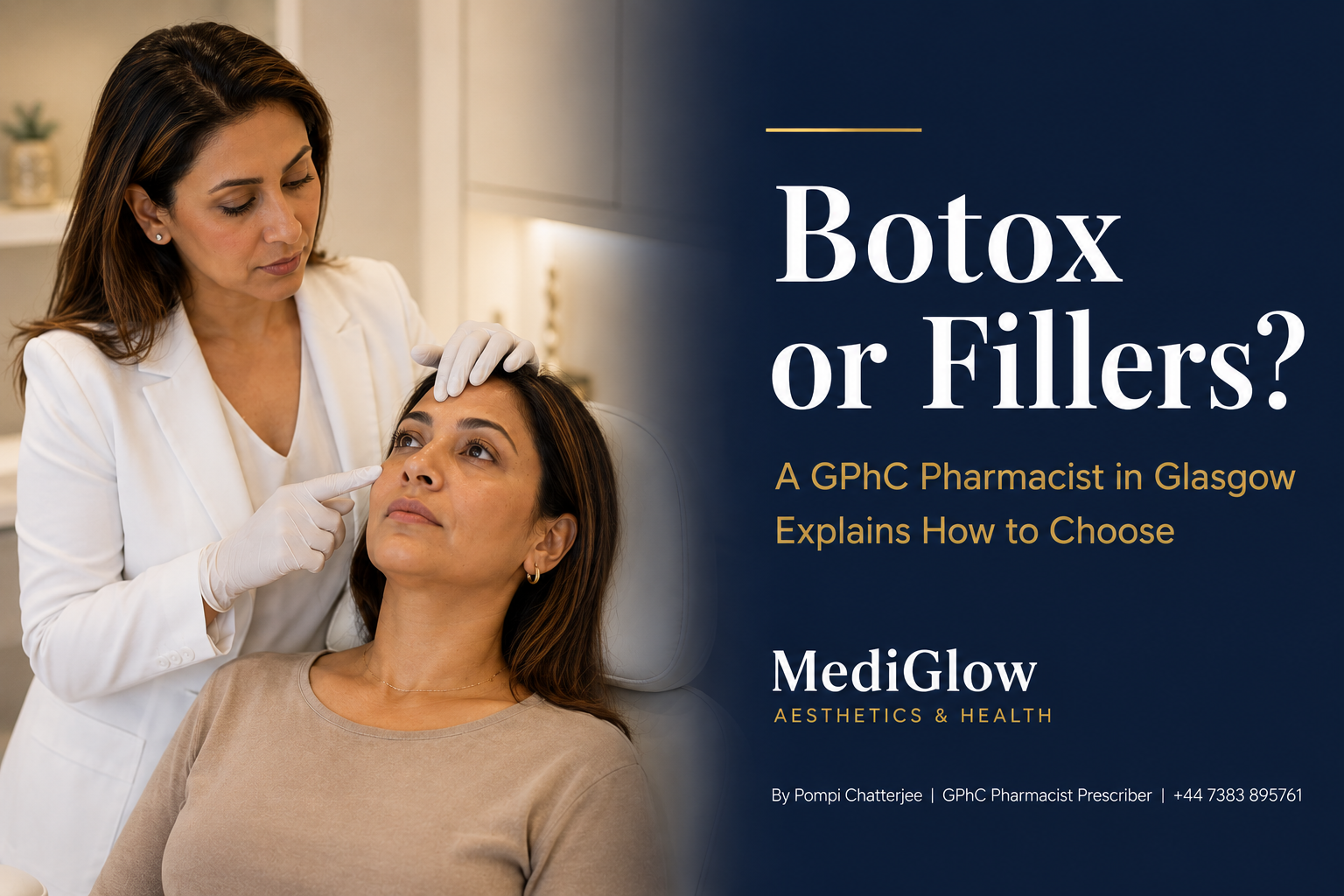


By Pompi Chatterjee, GPhC pharmacist independent prescriber at MediGlow Aesthetics & Health
The Scottish Parliament passed new legislation in March 2026 regulating non-surgical cosmetic procedures for the first time. That this is news tells you something important: until now, virtually anyone in Scotland could inject Botox or filler into your face with no legal obligation to hold a qualification, carry emergency medication, or register with any regulator.
430 people contacted Advice Direct Scotland about botched cosmetic procedures. Some were as young as 15. In England last summer, 38 cases of botulism were linked to unlicensed botox-like products used in cosmetic clinics. A BBC investigation exposed a former tattooist who had been posing as a doctor at an aesthetics clinic, leaving a patient permanently disfigured.
These are not rare edge cases. The Save Face register, a government-approved accreditation scheme, received almost 3,000 complaints in a single year, with two thirds relating to dermal fillers.
The good news is that you can protect yourself. These seven questions take about five minutes to ask before you book any aesthetics appointment. They work for any clinic in Glasgow, not just ours.
Are they registered with the GPhC, NMC, or GMC?
In Scotland, only a pharmacist, nurse, or doctor can legally prescribe the medicines used in aesthetic treatments. Botox (botulinum toxin) and many skin boosters are prescription-only medicines. This means the person treating you must either hold a prescribing qualification themselves or work under the supervision of someone who does.
Check the register before you book. The General Pharmaceutical Council (GPhC) maintains a public register at pharmacyregulation.org. The Nursing and Midwifery Council (NMC) register is at nmc.org.uk. The General Medical Council (GMC) register is at gmc-uk.org. You can search by name and verify registration status in under two minutes.
At MediGlow, both Lalit Matai and Pompi Chatterjee are GPhC-registered pharmacist independent prescribers. You can verify their registration directly on the GPhC public register. Registration numbers are available on request.
2. Do they have a prescribing qualification specifically?
Being registered as a pharmacist or nurse is not the same as being a prescribing pharmacist or prescribing nurse. The prescribing qualification is a separate postgraduate course that authorises a practitioner to independently assess a patient and prescribe medicines. Without it, a registered clinician would still need to obtain a prescription from a doctor for every patient.
Ask specifically: “Are you a prescribing pharmacist/nurse, or do you work under a prescriber?” The answer tells you whether your assessment and treatment are happening within a single clinical framework, or whether your prescription is being obtained informally or via a remote prescribing service.
MediGlow is a pharmacist independent prescriber-led clinic. This means every consultation, every assessment, and every treatment decision is made by a clinician who can legally and clinically own the full process.
3. Do they carry hyaluronidase and an emergency kit?
Vascular occlusion is the most serious complication in filler treatment. It happens when filler accidentally enters or compresses a blood vessel, cutting off the blood supply to the surrounding tissue. Without immediate treatment using hyaluronidase, an enzyme that dissolves hyaluronic acid filler, the results can include permanent skin damage, scarring, or in the most serious cases involving occlusion near the eye, vision loss.
Ask your clinic: “Do you carry hyaluronidase on site? Do you have a vascular occlusion protocol?” A clinic that hesitates or cannot answer this confidently is telling you something important. The JCCP (Joint Council for Cosmetic Practitioners) and Save Face accreditation both require hyaluronidase to be on site for any filler treatment.
This is one of the most important questions on this list because it only matters in an emergency, and emergencies do not announce themselves.
4. Do they take a full medical history before treating you?
Your medications, your health conditions, your allergies, and your previous treatments all affect whether an aesthetic procedure is safe for you at this moment. Blood thinners increase bruising risk. Some autoimmune conditions contraindicate certain treatments. Certain medications interact with the topical anaesthetics used in microneedling. Some skin conditions mean filler should be used in a different product or at a different depth.
A full medical history is not a five-minute form on a tablet while you sit in a waiting room. It is a clinical conversation with a qualified practitioner who understands the implications of what you are telling them. Ask: “Does the person carrying out my treatment take a full medical history and review my medications?” If the answer is that a therapist takes your form and a practitioner sees you briefly before treatment, that is a different level of oversight to what you deserve.
At MediGlow, the full medical consultation and the treatment are done by the same person. Your prescriber assesses you and treats you. There is no separation.
5. Are their before and after photos real patients with written consent?
Before and after photos are the primary way clinics demonstrate their work. They are also one of the most easily manipulated elements of marketing in this industry. Stock images, edited photos, and images sourced without patient consent all exist.
Ask: “Are your before and after photos your own patients? Do all patients give written consent for their photos to be used?” A reputable clinic will answer yes without hesitation and may be able to show you the consent process. The Advertising Standards Authority (ASA) requires that before and after photos not create unrealistic expectations and must be representative of typical results.
It is also worth looking at whether the photos show real variation. A portfolio showing only perfect results, always the same angle, always the same lighting, is worth scrutinising carefully.
6. What is their complication management protocol?
Every clinic, no matter how experienced, will occasionally see a complication. Bruising, infection, asymmetry, and in rare cases more serious vascular events are all possibilities. What separates a good clinic from a dangerous one is not whether complications ever happen but how they handle them when they do.
Ask: “If I have a complication after treatment, who do I contact and what happens?” The answer should include a named contact, a phone number that is answered, and a clear process. In Scotland from 2026, registered premises will be required to have documented complication protocols. Do not wait for regulation to ask this question. Ask it now.
A prescribing pharmacist can manage many post-treatment complications directly and can liaise with the patient’s GP or refer to secondary care where needed. A beauty therapist completing an aesthetics course over two weekends cannot.
7. Are they appropriately insured for the treatments they offer?
Aesthetics insurance is treatment-specific. A clinic insured for facial massage is not automatically insured for dermal filler or Botox. A practitioner insured as a nurse therapist may not have insurance cover that extends to independent prescribing decisions. Ask: “Do you hold appropriate insurance for this specific treatment, and is it current?”
You should also look for membership of professional bodies that carry indemnity as part of membership, such as the CMAC (Clinical Medics and Aesthetics Consortium). The Save Face register at saveface.co.uk is a government-approved accreditation scheme that lists practitioners who have voluntarily met standards including insurance requirements.
Why we are telling you this
At MediGlow in Thornliebank, Glasgow, we satisfy all seven of the criteria above. Lalit and Pompi are both GPhC-registered pharmacist independent prescribers. We carry hyaluronidase. Every patient receives a full medical and medication review. Every before and after photo is a real MediGlow patient who has given written consent. We have a clear complication protocol and hold appropriate prescriber insurance.
We are also being honest with you: we are a relatively new clinic in terms of years of trading. If length of trading history is something you factor into your decision, we will not pretend that ten years of reviews carries less weight than it does. What we can tell you is that our clinical credentials are robust, our regulatory standing is verifiable, and our pricing is fully transparent with no consultation fees.
If you want to verify our credentials before you book, search our names on the GPhC public register. Then compare the clinics you are considering against these seven questions and book with whichever one gives you the most complete answers.
If that turns out to be us, you can read more about our treatments at MediGlow or book a free consultation at The Glen Clinic, 1 Spiersbridge Way, Thornliebank, Glasgow. Call 07383 895761.