
Written by
Lalit Matai, Pharmacist Prescriber (GPhC 2086556) & Clinical Director, MediGlow Aesthetics & Health
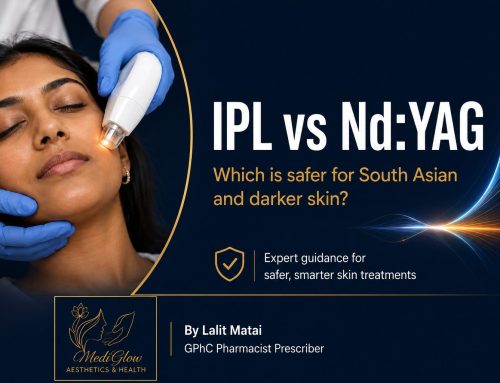
If you’ve been researching treatments for pigmentation, birthmarks or tattoos, you’ll have come across two names: Q-switched (nanosecond) Nd:YAG and picosecond Nd:YAG. They can sound like the same thing with a different label, but how they break down pigment is quite different, and that affects your comfort, your number of sessions and your results. At MediGlow we treat pigmentation with the Cutera Enlighten SR, a picosecond Nd:YAG system. Here is why.
The core difference: speed
Both technologies deliver very short bursts of energy that target melanin or tattoo ink in the skin. The difference is how short those bursts are.
- Q-switched Nd:YAG pulses last nanoseconds (billionths of a second), typically several nanoseconds per pulse.
- Picosecond Nd:YAG pulses last picoseconds (trillionths of a second). The Enlighten SR delivers 750-picosecond pulses, which is a markedly shorter pulse that concentrates the energy far more quickly.14
– Why MediGlow chose the Enlighten SR
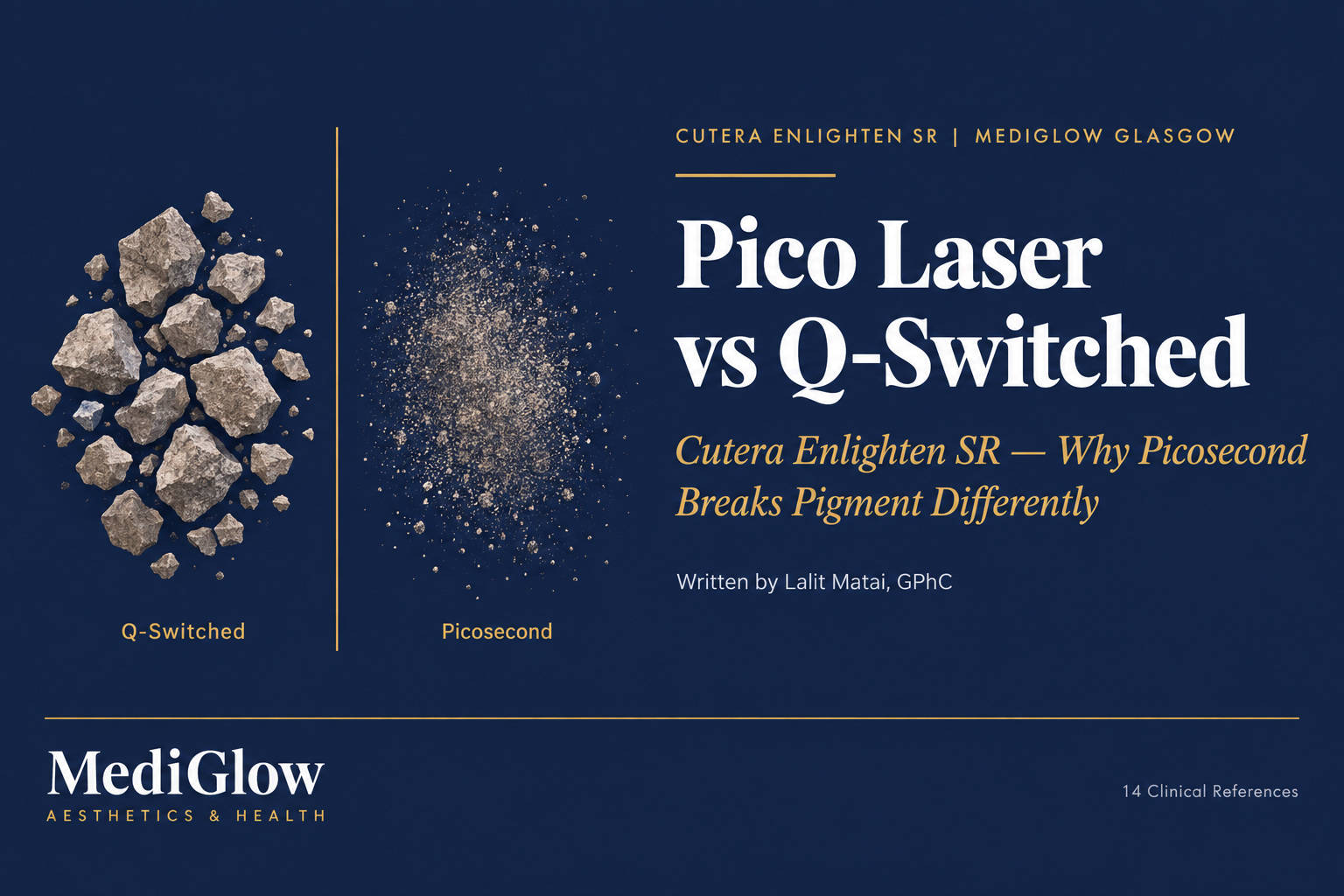
Pebbles vs fine dust
The easiest way to picture it is what happens to the pigment.
Q-switched Nd:YAG works mainly through a photothermal effect. The pigment absorbs the energy, heats up and breaks apart, but into relatively larger fragments, like pebbles. Your immune system has to clear those pieces gradually, and some may need a further pass before they’re small enough to go.
Picosecond Nd:YAG works mainly through a photoacoustic (mechanical) effect. The pulse is so brief that there’s little time for heat to build up. Instead, a pressure wave shatters the pigment into much finer particles, like dust. Dust is far easier for the body to clear than pebbles.1,14
What this means in practice: because Q-switched Nd:YAG leaves larger fragments, it generally takes more sessions to reach the same result. Picosecond often achieves it in fewer sessions.2,3 Exact numbers vary with the pigment type, its depth, your skin type and your body’s response, so a good practitioner won’t promise a set number.
What the research shows
Several head-to-head studies have compared the two approaches. In split-face and split-lesion trials, picosecond treatment has shown better clearance, less discomfort and a lower risk of
post-inflammatory hyperpigmentation than nanosecond treatment for a number of pigmented lesions, including in Asian and darker skin types.2,3,4 It is fair to say that most of this research used a range of picosecond devices and wavelengths, not the Enlighten SR specifically, and results differ between studies and between conditions.
Heat matters, especially with melasma
Because Q-switched Nd:YAG relies more on heat, it puts more thermal stress on the surrounding skin. Picosecond delivers far less heat, which is why it’s often gentler and carries a lower risk of post-inflammatory hyperpigmentation. That’s an important consideration for deeper skin tones.1,2,3
Melasma is where this matters most. It is a complex, easily triggered condition, and it is very unforgiving when heat is used as the treatment method. Heat can stimulate the pigment-producing cells and make melasma darker or bring it back stronger. Treating it needs careful assessment, a cautious low-energy approach, and a proper skin and sun-protection routine alongside.1,5 Melasma is usually a condition to be managed rather than “cured”, and any clinic promising a one-off fix should raise questions.
Which conditions can be treated?
Hori’s naevus is a blue-grey to brown pigmentation, usually across the cheeks, temples or upper face, and is more common in people of Asian descent. It sits deeper in the skin (the dermis), and it’s often mistaken for melasma. The two can also occur together, so an accurate diagnosis is essential.6,7,8 Q-switched Nd:YAG is a well-established treatment for it, though it typically needs multiple sessions. Picosecond can help too, with its finer fragmentation and lower heat, and may reduce the number of sessions needed.4,9
Café-au-lait macules are flat, light-brown patches that are often present from birth or childhood. They can respond to both technologies, but results are less predictable than with other pigment. Some clear well, some fade only partially, and some can return after treatment. A test patch is a sensible first step, and honest expectations are important.10,11,12,13
Other concerns that may be suitable include sun spots, freckles and unwanted tattoo ink, depending on assessment.
About the Cutera Enlighten SR
The Enlighten SR is a picosecond Nd:YAG system built around two wavelengths, 1064 nm and 532 nm, which target pigment at different depths and in different colours, delivered in 750-picosecond pulses. Cutera describes its action as photoacoustic, breaking pigment apart with minimal heat to the surrounding tissue.14
- Low-heat approach: a good fit for patients who need gentler energy, including those with deeper skin tones.
- PicoGenesis: a low-fluence, full-face treatment aimed at uneven tone and overall skin quality.
- Micro Lens Array (MLA) handpiece: non-ablative fractional resurfacing for skin texture and acne scars.
- Prescriber-led care: every plan starts with a clinical assessment, so the technology is matched to your skin and not the other way round.
Is picosecond always better?
Q-switched Nd:YAG has decades of evidence behind it and remains a valid option for many patients. For the concerns above, though, our view is that picosecond Nd:YAG offers real advantages: finer fragmentation, less heat and often fewer sessions. That is why we invested in it. The right choice still depends on:
- the type of pigment
- how deep it sits
- your skin tone and how it tends to react
- your history, medications and goals
Why a proper assessment matters
The technology matters, and so does the person using it. A good practitioner will:
- Assess your skin and identify exactly what type of pigment you have
- Explain which specific technology is being used and why it suits you
- Perform a patch test where appropriate
- Give clear aftercare advice, including strict sun protection
If a clinic can’t tell you exactly what technology they’re using, or promises the same result for everyone, ask more questions.
Conclusion
Both Q-switched Nd:YAG and picosecond Nd:YAG aim to break down unwanted pigment safely.
Q-switched Nd:YAG breaks it into pebbles using more heat, which can mean more sessions. The Cutera Enlighten SR breaks it into fine dust with far less heat, which can mean fewer sessions and a gentler experience, and matters most in heat-sensitive conditions like melasma. The best plan is the one matched to your skin and your concern after a proper consultation.
Thinking about pigmentation treatment?
Book a consultation at MediGlow in Thornliebank, Glasgow and we’ll assess your skin and talk you through the options.
References
- Lee et al. The efficacy and safety of a low-fluence 1064 nm picosecond Nd:YAG compared with a low-fluencephotoacoustic (PTP) mode 1064 nm Q-switched Nd:YAG for melasma: a prospective split-face study. Dermatol Ther. 2023;2023:5961152. doi:10.1155/2023/5961152
- Ungaksornpairote C, Manuskiatti W, Junsuwan N, Wanitphakdeedecha R. A prospective, split-face, randomizedstudy comparing picosecond to Q-switched Nd:YAG for treatment of epidermal and dermal pigmented lesions in Asians. Dermatol Surg.
- Levin MK, Ng E, Bae YS, Brauer JA, Geronemus RG. Treatment of pigmentary disorders in patients with skin ofcolor with a novel 755 nm picosecond, Q-switched ruby, and Q-switched Nd:YAG nanosecond lasers: a retrospective photographic review. Lasers Surg Med.
- Ge Y, Yang Y, Guo L, et al. Comparison of a picosecond alexandrite laser versus a Q-switched alexandrite laser forthe treatment of nevus of Ota: a randomized, split-lesion, controlled trial. J Am Acad Dermatol. 2020;83:397-403.
doi:10.1016/j.jaad.2019.03.016
- Rajaratnam R, Halpern J, Salim A, et al. Interventions for melasma. Cochrane Database Syst Rev.
2010;(7):CD003583. doi:10.1002/14651858.CD003583.pub2
- Park JM, Tsao H, Tsao S. Acquired bilateral nevus of Ota-like macules (Hori nevus): etiologic and therapeuticconsiderations. J Am Acad Dermatol. 2009;61:88-93.
- Hori Y, Kawashima M, Oohara K, Kukita A. Acquired, bilateral nevus of Ota-like macules. J Am Acad Dermatol.
1984;10:961-964.
- Kaur H, Sarma P, Kaur S, et al. Therapeutic options for management of Hori’s nevus: a systematic review.
Dermatol Ther. 2020;33:e13167.
- Chua KR, Ghotmi M, Vankayalapati DK, et al. Efficacy and safety of 755-nm picosecond alexandrite laser foracquired bilateral naevus of Ota-like macules (Hori naevus): a systematic review and meta-analysis. PubMed PMID 42665953.
- Cen Q, Gu Y, Luo L, et al. Comparative effectiveness of 755-nm picosecond laser, 755- and 532-nm nanosecondlasers for treatment of café-au-lait macules (CALMs): a randomized, split-lesion clinical trial. Lasers Surg Med.
2021;53(4):435-442.
- Fernandez JK, Guo EL, Richmond H, Friedman PM. The 730 nm picosecond titanium sapphire laser for treatmentof café-au-lait macules in all skin types. Lasers Surg Med. 2024;56:257-262. doi:10.1002/lsm.23769
- Liu et al. Characteristics of skin lesions determine the therapeutic response of facial café au lait macules lasertherapy. J Cosmet Dermatol. doi:10.1111/jocd.70062
- Treatment of café-au-lait macules with picosecond and nanosecond 1064-nm Nd:YAG: a retrospective study.Lasers Med Sci. doi:10.1007/s10103-025-04296-z
- enlighten SR product information (manufacturer material; 532/1064 nm, 750 ps). cutera.com. Accessed20 September 2026.
About the Author
Lalit Matai
Pharmacist Prescriber (GPhC 2086556)
Clinical Director
MediGlow Aesthetics & Health
The Glen Clinic, Thornliebank, Glasgow G46 8NG