
By Lalit Matai, Pharmacist Independent Prescriber, MediGlow Aesthetics & Health, Glasgow
If you’ve lived with melasma, you know it’s frustrating. The brown-grey patches on the cheeks, forehead and upper lip can fade with one treatment and return with the next holiday, hormone shift or bout of stress. It’s also one of the few pigment conditions where the wrong treatment can make things worse.
That’s why the type of device matters so much. Let’s look at why.
Melasma isn’t just “too much pigment”
Melasma is a chronic, relapsing condition. Pigment-producing cells (melanocytes) are overactive, but so are the surrounding blood vessels, inflammatory signals and the skin’s structural layers.[1] Hormones, UV and visible light, and heat all play a part.
This matters because heat and inflammation are triggers. A treatment that overheats the skin can switch melasma back on, leaving you darker than when you started.
Why “laser” isn’t one thing
“Laser” covers very different technologies, and they behave very differently on melasma:
- Long-pulse Nd:YAG or other heat-based devices. These work by heating tissue. Ideal for hair removal, but heat is exactly what melasma-prone skin doesn’t tolerate well.
- Q-switched nanosecond Nd:YAG. Used at low fluence, it has shown benefit as an adjunct, but results vary and relapse is common.[2]
- Picosecond lasers. These deliver energy in trillionths of a second. The effect is mainly photoacoustic: a rapid pressure wave shatters pigment into tiny fragments for the body to clear, with far less heat spread into surrounding skin.[3]
- Intense pulsed light (IPL). This isn’t a laser at all, and broad-spectrum heat can aggravate melasma in susceptible skin.
What the research says about picosecond lasers
Pooled trials show picosecond lasers reduce melasma severity scores (MASI/mMASI), though results vary widely between studies.[4]
- A meta-analysis of randomised trials found the 1064 nm picosecond Nd:YAG was safe and effective. A 755 nm picosecond laser was not clearly better than topical depigmenting creams.[4]
- In a 24-week trial of 60 people (Fitzpatrick skin types III-IV), a non-fractional picosecond Nd:YAG improved melasma more than both a picosecond alexandrite laser and 2% hydroquinone cream.[5]
- A network meta-analysis of 20 studies (1,182 patients) found the best results came from combining a 1064 nm picosecond laser with tranexamic acid.[6]
- A 2025 meta-analysis reported recurrence of around 6-13%, similar to comparator treatments.[7][8]
- A low-fluence 730 nm picosecond laser has shown promise, but the evidence is still early and retrospective.[9]
The honest caveat: studies differ widely in settings, skin types and follow-up, and much of the evidence is low quality.[7][8] Picosecond lasers are a promising tool, not a cure.
Why wavelength, energy and settings matter
- Wavelength: 1064 nm penetrates deeper and is less absorbed by surface melanin, making it the best-supported option for melasma, particularly in darker skin.[4]
- Pulse duration: Picosecond pulses limit heat build-up compared with longer pulses.
- Fluence: Melasma responds to gentle, low-energy Aggressive settings risk rebound pigmentation.
- Skin type: Darker skin (Fitzpatrick III-VI) is more prone to post-inflammatory hyperpigmentation, so settings must be individualised.
Treatment works best as a plan
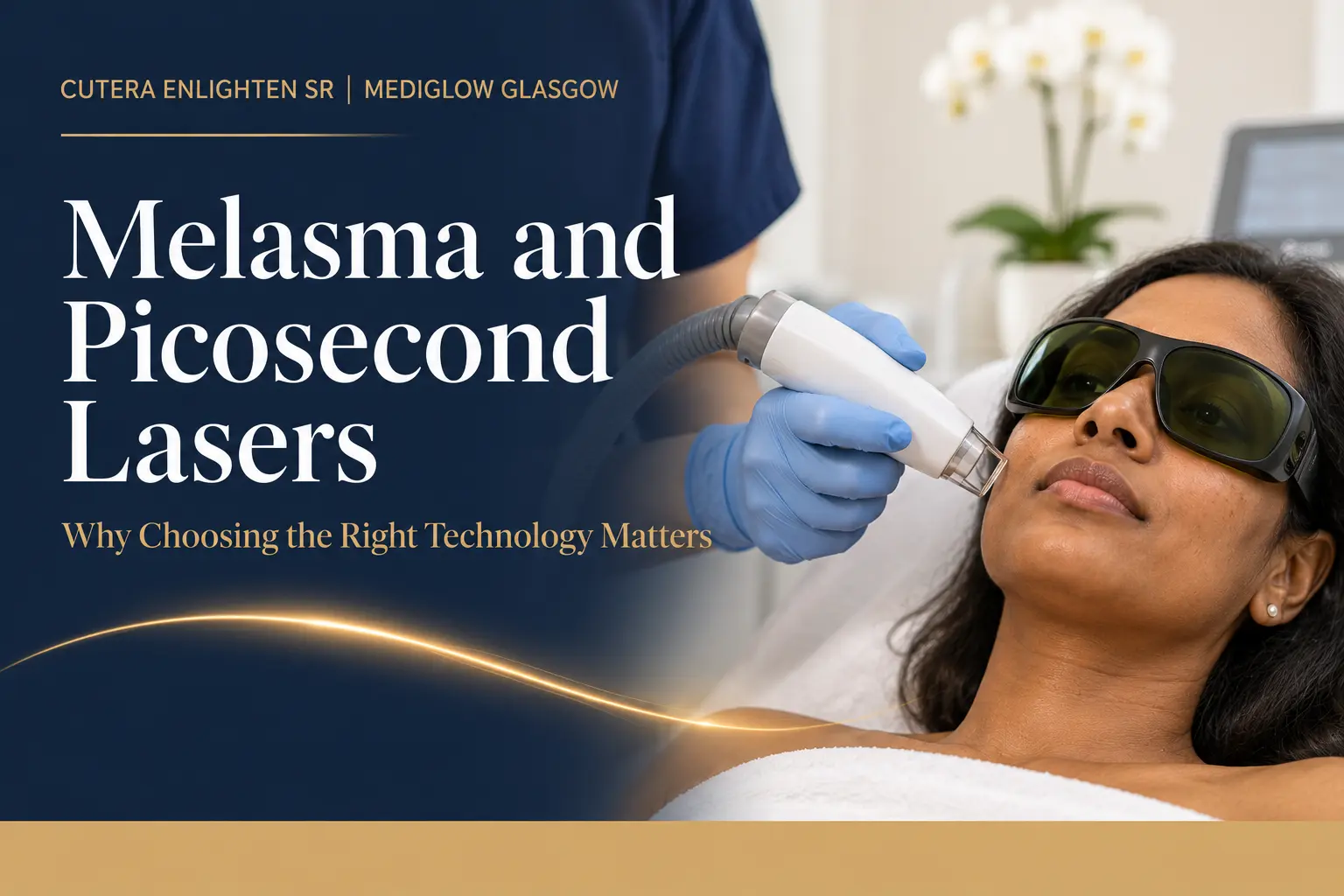
At MediGlow, our Cutera Enlighten SR is a picosecond Nd:YAG platform, and we use it as one part of a wider plan rather than a stand-alone fix:
- Prescriber-led assessment to confirm it’s melasma and not another pigment condition, and to check hormones, medications and triggers.
- Barrier repair and daily broad-spectrum SPF, ideally tinted with iron oxides to block visible light.
- Medical-grade topicals and, where appropriate, prescription options.
- Gentle, low-fluence 1064 nm picosecond sessions with careful test areas.
- Ongoing maintenance, because melasma is managed, not “cured”.[8] Results vary, and no reputable clinic can promise permanent clearance.
Questions to ask any clinic
- Which exact type of device do you use, and at what wavelength?
- Have you treated melasma before, and on my skin type?
- Will you patch test first?
- What’s the plan if pigment worsens?
- How will we manage recurrence?
If the answer is just “we use a laser”, keep looking.
Thinking about treating melasma?
Book a consultation at The Glen Clinic, Thornliebank, Glasgow, or contact info@medi-glow.co.uk. This article is for general information and isn’t medical advice.
References
- Passeron T. Melasma pathogenesis and influencing factors: an overview of the latest research. J Eur Acad Dermatol Venereol. 2013;27(Suppl 1):5-6.
- Wattanakrai P, et al. Low-fluence Q-switched neodymium-doped yttrium aluminum garnet (1,064 nm) laser for thetreatment of facial melasma in Asians. Dermatol Surg. 2010;36(1):76-87.
- Chehrara et al. The efficacy of laser therapy in melasma treatment: a systematic review and meta-analysis. J Cosmet Dermatol. doi:10.1111/jocd.70602
- Efficacy and safety of picosecond laser for the treatment of melasma: a systematic review and meta-analysis.
Lasers Med Sci. 2023. doi:10.1007/s10103-023-03744-y (PMID 36897459)
- Liang et al. (2023), non-fractional picosecond Nd:YAG vs picosecond alexandrite vs 2% hydroquinone, assummarised in ref. 3.
- Efficacy and safety of picosecond laser in the treatment of melasma: a network meta-analysis. Dermatol Surg. doi:10.1097/DSS.0000000000003775
- Efficacy of picosecond laser treatment in melasma: systematic review. RSU Research Conference proceedings,2026 (IN26-056).
- Laser-based therapies for melasma: systematic review and meta-analysis. PubMed PMID 42064496 (2026).
- Efficacy and safety of low-fluence 730-nm picosecond laser in melasma. Dermatol Surg.