
Genesis for Rosacea: How Long-Pulse Nd:YAG Treatment May Help Redness, and How Many Sessions You Might Need
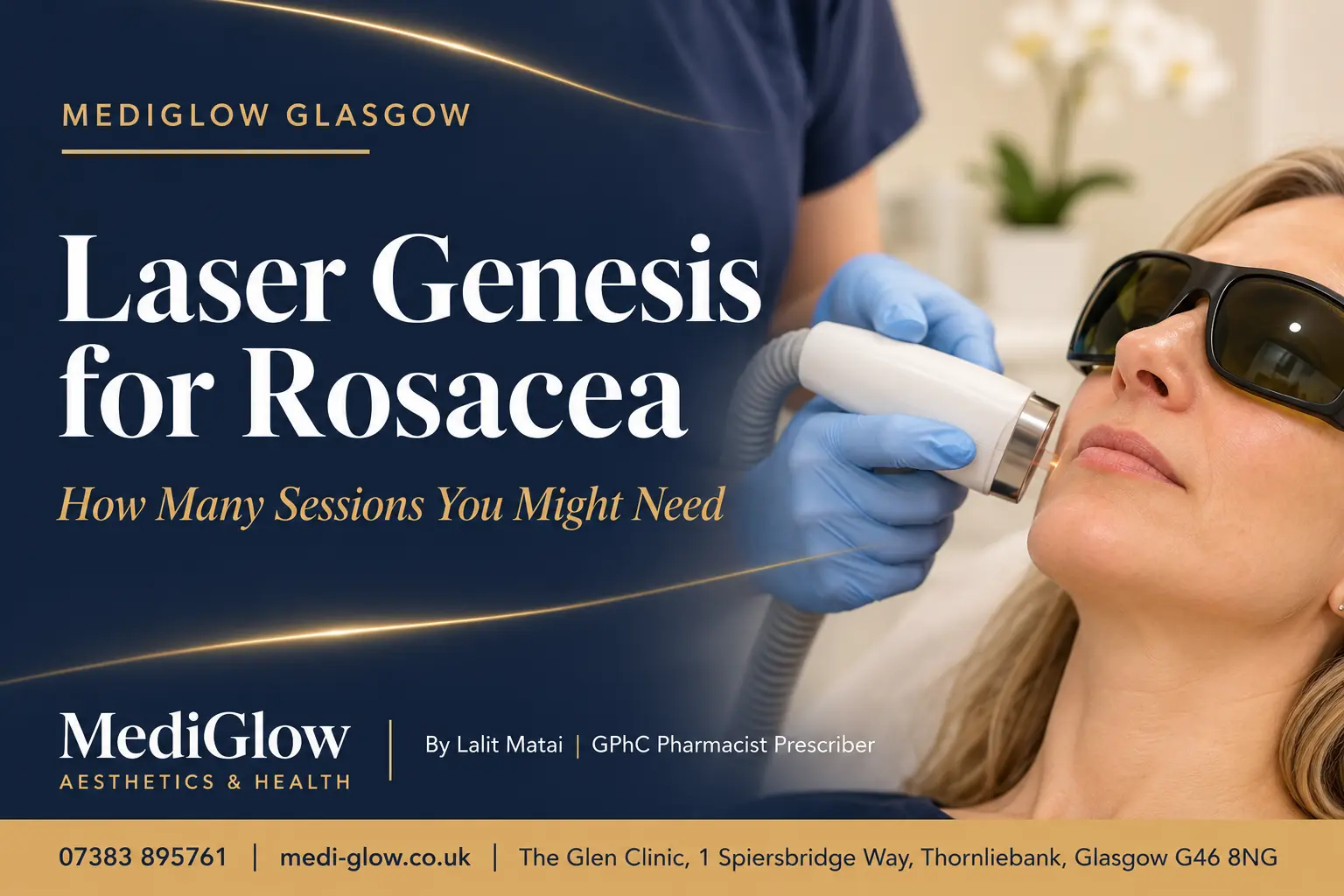
Rosacea can mean persistent redness, flushing, visible vessels and skin that reacts to everything. There is no cure, but treatment can help you manage it. One option we offer is Genesis, a gentle long-pulse 1064nm Nd:YAG treatment.
How does Genesis work?
Genesis uses a 1064nm Nd:YAG in a micropulsed mode: very short, low-energy pulses that gently warm the skin without damaging the surface. This approach is described as minimising redness and downtime, with a reported increase in collagen [5].
Rosacea redness is driven by dilated, reactive blood vessels near the surface, along with ongoing inflammation. Genesis may help in three ways:
- Targeting superficial vessels. The 1064nm wavelength is absorbed by haemoglobin and penetrates deeper than many visible-light devices. Gentle heating of these vessels can reduce persistent background redness.
- Calming inflammation. In a preclinical study, rosacea-like mouse skin treated with a long-pulse Nd:YAG showed reduced redness and vessel changes, along with increased dermal collagen [4].
This was in mice, so it shows a plausible mechanism, not proof in people.
- Supporting collagen and skin quality. Controlled warming of the dermis may improve texture and tone over time.
What does the evidence show?
Research on 1064nm Nd:YAG for rosacea is encouraging but still developing. Most studies are small, and settings vary between devices.
- In a small study of 10 patients with erythematotelangiectatic and papulopustular rosacea, participants had 5 sessions every 3 weeks. Improvement averaged between 28.5% and 57.5%, and half improved by more than 50%. All patients reported fewer flare episodes, and side effects were limited to mild redness and swelling that settled within 12 hours [1].
- In a study of 23 patients with rosacea-related telangiectasia, three months after the final session 13 patients had excellent clearance and 8 had good clearance [2].
- In a comparison of 40 patients with papulopustular rosacea, fractional Nd:YAG reduced the area of redness by 79%, compared with 22% for standard retinoid treatment [3].
How many sessions will I need?
It depends on your rosacea type and severity. In published studies, protocols typically use around 4 to 5 sessions. One registered trial protocol plans up to four sessions two weeks apart [6], and the study above used five sessions three weeks apart [1].
At MediGlow, a typical plan is a course of 4 to 6 sessions spaced 2 to 4 weeks apart, with maintenance sessions afterwards to keep results. We’ll set your plan at consultation and adjust it based on how your skin responds.
What to expect
Treatment is usually comfortable, with a feeling of warmth. Sessions take around 20 to 30 minutes. Mild pinkness afterwards usually settles within hours, and most people return to normal activities straight away. Rosacea is chronic, so the aim is improvement and management, not a permanent cure. Results vary.
Is it right for you?
We’ll assess your rosacea type, triggers, current medications and skin tone. Active flare-ups, recent sun exposure or tanning, and certain medical conditions may mean treatment is delayed or unsuitable. Daily SPF 30–50, gentle fragrance-free skincare and trigger avoidance will support your results.
Book a consultation at MediGlow Aesthetics & Health, The Glen Clinic, Thornliebank, Glasgow.
Results vary between individuals. Suitability is determined at consultation.
References
- Long-Pulsed 1064 nm Nd:YAG for treatment of rosacea (10 patients). J Am Acad Dermatol, 2024 abstract. https://www.jaad.org/article/S0190-9622(24)01081-8/fulltext
- Use of Long Pulse Nd:YAG 1064nm Laser for Treatment of Rosacea Telangiectatica (Fotona). https://www.laserandhealthacademy.com/media/objave/academy/priponke/5_use_of_long_pulse_nd_yag_1064_nm_laser_for_treatment _of_rosacea_telangiectatica.pdf
- High-energy Nd:YAG laser therapy for papulopustular rosacea: quantitative assessment with digital imageprocessing. PubMed 41620863. https://pubmed.ncbi.nlm.nih.gov/41620863/
- Kim M, et al. 1064-nm Nd:YAG laser ameliorates LL-37-induced rosacea-like skin lesions through promotingcollagen remodeling in BALB/c mice. Lasers Med Sci. 2018;33:393-397.
- The dual toning technique for melasma treatment with the 1064 nm Nd:YAG laser (describes the Genesismicropulsed technique). PMC3799028. https://pmc.ncbi.nlm.nih.gov/articles/PMC3799028/
- Long Pulse 1064 nm Nd:YAG Laser in the Treatment of Erythematotelangiectatic Rosacea (registered protocol,NCT06908915). https://clinicaltrials.gov/study/NCT06908915