
Written by Lalit Matai, GPhC Registered Pharmacist Independent Prescriber (GPhC 2086556) · Co-founder & Clinical Director, MediGlow Aesthetics & Health
Why Choosing the Right Hair Removal Technology Matters for Darker Skin
If you have brown or black skin, the device used for hair removal matters as much as the person holding it.
The wrong wavelength can leave you with burns, dark marks or patchy pigment. The right one can give you smooth, long-lasting hair reduction with very little risk. Here is why.
What is the Fitzpatrick scale?
The Fitzpatrick scale was developed by Dr Thomas Fitzpatrick in 1972. It classifies skin by its colour and its tendency to burn or tan in sunlight. It runs from Type I to Type VI:
| Type | Typical features | Sun response |
| I | Very fair, often red or blonde hair | Always burns, never tans |
| II | Fair | Burns easily, tans minimally |
| III | Light olive or medium | Sometimes burns, tans gradually |
| IV | Olive or light brown | Rarely burns, tans easily |
| V | Brown | Very rarely burns, tans darkly |
| VI | Deep brown to black | Almost never burns |
The scale matters because of melanin, the pigment that gives skin its colour. Hair removal works by heating the melanin in the hair follicle. The higher your Fitzpatrick type, the more melanin sits in the top layer of your skin (the epidermis) as well. Light aimed at the follicle therefore has to get past a lot of competing pigment.
Why IPL is not suitable for darker skin
IPL (intense pulsed light) is not a laser. It is a flash lamp that fires a broad band of wavelengths, roughly 500 to 1200 nm. That has two consequences:
- It cannot be tuned to skin colour. The shorter wavelengths in the band are strongly absorbed by epidermal melanin, so the surface of the skin heats up as well as the follicle.
- Melanin competes with the target. In Fitzpatrick types IV to VI, the extra epidermal melanin competes for light absorption, which raises the risk of unintended thermal injury, and IPL is generally not recommended above type III.
A trial of IPL in Fitzpatrick types II to IV found erythema in 87% of patients, hyperpigmentation in 60%, blisters in 20% and hypopigmentation in 20%, with darker skin and higher fluence both linked to more severe side effects. That was under standardised clinical protocols, which shows how narrow the safety margin is. A published case report describes a Fitzpatrick IV patient who developed second-degree burns after IPL at a non-medical spa, where settings were not individualised and his pain was dismissed.
Newer IPL devices have improved, but for darker skin a single, longer wavelength is a much safer design.
Why wavelength and penetration depth matter
Every hair removal device is a trade-off between two things:
- Melanin absorption. You want the follicle to absorb energy, not the skin above it.
- Penetration depth. The follicle bulb sits deep in the dermis. Follicles can lie more than 2 mm below the surface, and the epidermis contains additional melanin that light must pass through first.
Shorter wavelengths are absorbed more by melanin, which is why they work well on pale skin with dark hair. In darker skin, much of that energy is absorbed by the heavily pigmented basal layer. Depth of transmission increases steadily with wavelength between 400 and 1,200 nm, and melanin absorption is lower at longer wavelengths. A longer wavelength lets more energy bypass the surface and reach the follicle.
Alexandrite (755 nm)
The alexandrite laser is excellent on lighter skin because melanin absorbs it so strongly. On darker skin that same strong absorption is the problem. In skin types IV to VI, alexandrite (755 nm) and diode (810 nm) lasers are limited by high melanin absorption, so energy has to be reduced to avoid skin damage. Modelling work comparing the two found that transmission of the alexandrite laser at a given skin depth fell to just 11% in dark skin and 13.5% in medium skin. Most of the energy is lost in the epidermis before it reaches the follicle.
Diode (around 800 to 810 nm)
The diode laser penetrates somewhat deeper than alexandrite and is widely used on medium skin. StatPearls describes the 810 nm diode as safer in darker skin, covering types I to V. Even so, its wavelength is still strongly absorbed by melanin. Shorter wavelengths such as 755 and 810 nm remain highly susceptible to melanin absorption and offer limited energy penetration. For our deepest skin tones, that margin is too thin.
Nd:YAG (1064 nm)
The Nd:YAG laser sits in the near-infrared, where melanin absorbs far less. It offers better penetration, less epidermal damage and relatively lower melanin absorption, and it is the option suited to skin types I to VI. With less energy absorbed by epidermal melanin, more can be delivered to deeper structures like the hair follicle. This is why it is the standard choice for Fitzpatrick IV to VI.
The evidence supports it. In a 2025 study of 55 women with Fitzpatrick IV to VI skin, no adverse events or paradoxical hypertrichosis were observed, and the authors concluded that low-fluence 1064 nm Nd:YAG is safe and effective in darker skin types.
Why we use the Cutera xeo+
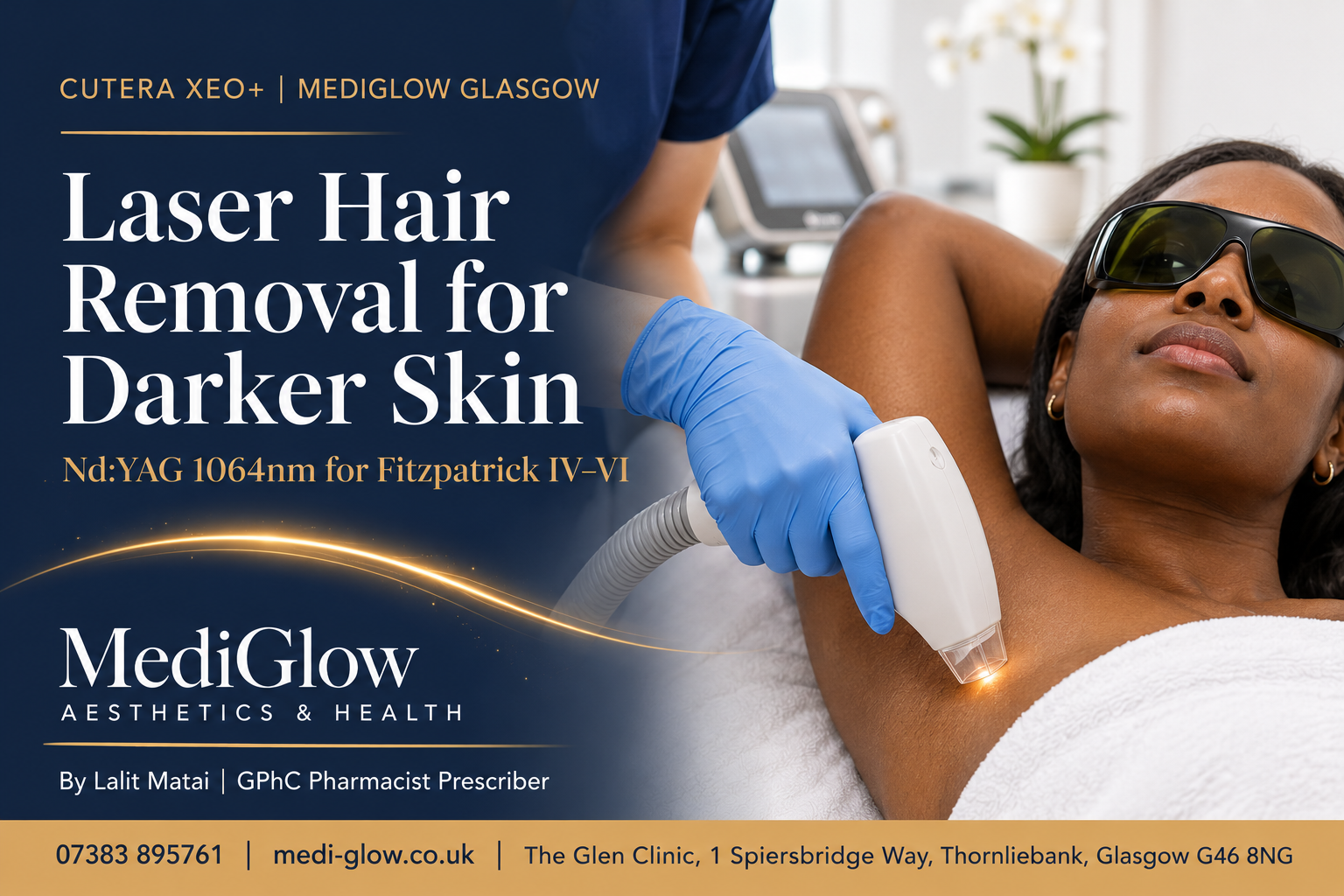
At MediGlow, we treat darker skin with the Nd:YAG handpiece on the Cutera xeo+. The platform includes a 1064 nm Nd:YAG laser alongside IPL options, and is indicated for all skin types, Fitzpatrick I to VI. We choose the 1064 nm wavelength for hair reduction on Fitzpatrick IV to VI. Every treatment starts with a skin assessment, patch testing and settings tailored to you, including fluence and pulse duration. Lower fluences and longer pulse durations are suggested for darker skin, and cooling before and after treatment helps prevent pigment changes.
An honest note: because Nd:YAG is less attracted to melanin, it works best on dark, coarse hair. Very fine, light or grey hair responds less well. We will tell you this at consultation rather than promise results the technology cannot deliver.
What can happen if the wrong device is used
- Burns and blistering. Too much energy is absorbed at the surface, and the epidermis overheats.
- Post-inflammatory hyperpigmentation (PIH). This is dark marks left after skin has been inflamed. Inflammatory mediators activate melanocytes, and PIH tends to be more prominent and longer-lasting in Fitzpatrick III to VI, who have larger melanosomes and more melanin. Sun exposure makes it worse. It can take months to fade.
- Pale patches appear where pigment cells have been damaged, and these can be much harder to reverse than PIH.
- This is rare, but it can follow deeper burns.
- Poor results. If settings are turned down to avoid burns, there may be too little energy at the follicle, so hair keeps growing back.
The risk of hyperpigmentation or hypopigmentation after light-based procedures is higher in
Fitzpatrick types IV to VI. Choosing the right technology first is far better than treating a complication later.
“Strawberry skin” and follicle irritation
“Strawberry skin” (often called strawberry legs) is a popular term for the red, brown or dark-dotted look of hair follicles. It is commonly linked with shaving-related folliculitis, enlarged pores and ingrown hairs, and it tends to show more on darker skin because irritation there leaves visible pigmented marks. Reducing the hair itself with Nd:YAG can lessen the shaving and ingrowns that cause it. A device that overheats the skin can make it worse by adding inflammation around each follicle, which is one more reason wavelength selection matters.
The bottom line
Darker skin needs the right wavelength, a properly cooled treatment and a prescriber who assesses your skin, not just a device that “works on everyone”. If you are considering hair removal, book a consultation. We will assess your Fitzpatrick type, hair type and treatment goals, and tell you honestly what to expect.
References
- Fitzpatrick TB. The validity and practicality of sun-reactive skin types I through VI. Arch Dermatol.
1988;124(6):869-871.
- Laser Fitzpatrick Skin Type Recommendations. NCBI Bookshelf, NBK557626.
- Laser Hair Removal. NCBI Bookshelf, NBK507861.
- Nd:YAG Laser Hair Removal in Fitzpatrick Skin Types IV to VI. J Drugs Dermatol. 2013;12(3):366-367.
- Comparison of Alexandrite and Diode Lasers for Hair Removal in Dark and Medium Skin: Which is Better? J Lasers Med Sci. PMC4281988.
- Efficacy and safety of 1064 nm Nd:YAG laser for hair removal in Sudanese women: a study on Fitzpatrick skin types IV-VI. PubMed 40892306 (2025).
- Pall et al. Triple-wavelength diode laser (810, 940, 1060 nm) in the Asian population. J Cosmet Dermatol. 2025.
doi:10.1111/jocd.70231.
- Second-degree burns following intense pulsed light therapy in a patient with Fitzpatrick skin type IV: a case report.
PMC12433457 (includes discussion of Thaysen-Petersen et al. IPL trial).
- Treatment of post-inflammatory hyperpigmentation in skin of colour: a systematic review.
- Cutera xeo+ product and indications page, cutera.com.